Teaching Piano Lead Sheets: A Step-by-Step Christmas Resource for Teachers and Students
“I’d love to teach lead sheets—but I’m not quite sure where to begin.”
If that sounds familiar, you’re one of the teachers I had in mind when I created 20 Favorite Christmas Songs: How to Play Lead Sheets.
Learning to play from chord symbols involves several skills. Students need to understand the symbols, find the chord tones, and decide how to turn those notes into an accompaniment. Teachers need a practical way to guide that process.
My goal was to put those steps within reach, using Christmas songs students already know and enjoy.
When piano educator Garreth Brooke reviewed the book for PianoCreativity, I was pleased that he recognized its usefulness for both students and teachers. Here are some of the features he explored—and why they matter in a piano lesson.
A progression that helps you choose where to begin
Garreth noted that the progressively ordered carols make it easier to choose an appropriate starting point.
The book moves from elementary through intermediate and beyond. You can begin where your student needs help, whether that means understanding a basic chord or exploring a more developed arrangement.
A student’s reading level and lead-sheet experience may be quite different. A capable reader can still benefit from taking time to connect a chord symbol with the notes under their fingers.
Guidance for teachers new to lead sheets
Garreth also identified the book as a useful introduction for teachers who haven’t taught lead sheets before.
That was an important part of my purpose. Teachers deserve clear explanations, too! Instructions and example arrangements provide something concrete to work through with a student.
You might begin by asking: What does this chord symbol tell us? Which notes belong to the chord? How could we use them underneath the melody?
Those questions create a practical connection between theory and playing.
Opportunities for students to explore independently
The review highlights instructions that allow students to investigate on their own, then extend their learning in lessons.
I love giving students something they can bring back to share. Instead of only asking, “Did you practice?” we can ask, “What did you discover?”
A student might arrive with a question, an accompaniment they enjoyed, or an idea that needs a little help. Each gives us something musical to discuss.
A starting point for teens and adults, too
Garreth points out that intermediate teens and adults who are new to lead sheets can move through the basics before exploring the later material.
Being new to chord symbols doesn’t mean being new to the piano. Familiar Christmas repertoire gives these players a chance to apply an existing musical skill in a different way.
Accompaniments that develop alongside understanding
Garreth praised the planned progression of accompaniments and the theory explanations along the way.
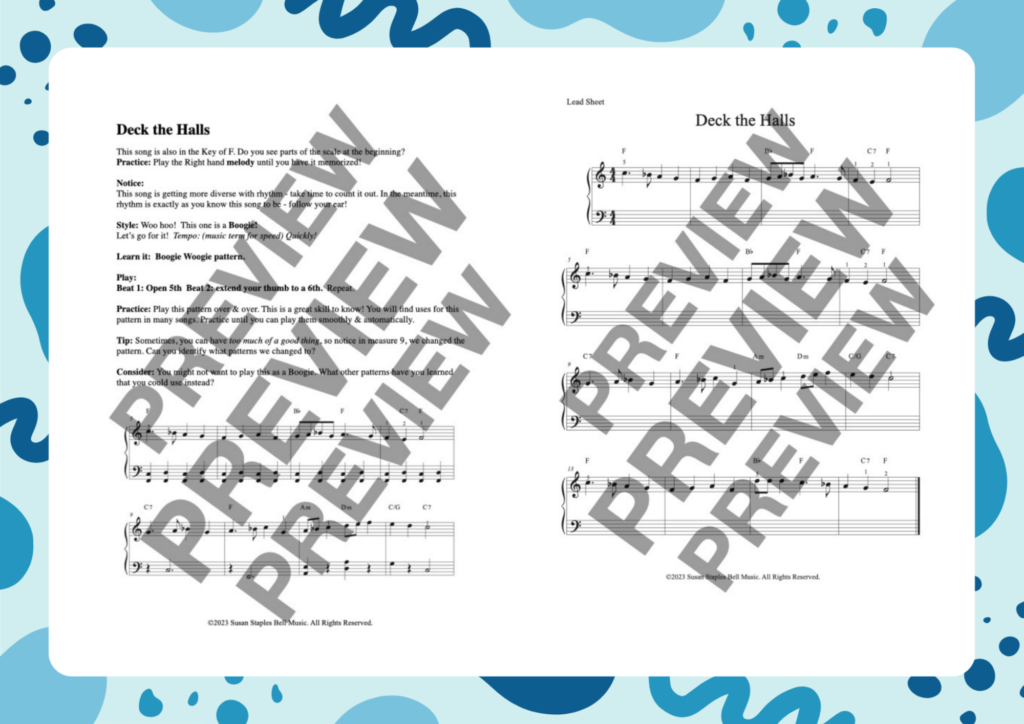
In the book, chord symbols appear in letter names and notation, with left-hand patterns, style suggestions, and ideas for arranging and improvising.
The teaching opportunity is to connect each pattern with its sound. What makes an accompaniment feel flowing, rhythmic, gentle, or full? When students listen to those differences, they begin making decisions about the music.
Space to write—and references to revisit
The review also draws attention to space for students’ own left-hand notation and the supporting reference pages.
Writing down an idea gives students something to examine, remember, and develop. They don’t have to write a complete arrangement to benefit; a measure or two can begin a useful conversation.
The book also includes chord-building guidance, chord formulas, scales, triads, inversions, and other references to revisit as questions arise.
A resource you can use across your studio
The digital book includes a studio license for use with students in your private studio.
That gives you flexibility to choose material for different students rather than expecting everyone to follow the same path. One student may need a simple introduction, while another is ready to experiment with arranging.
And although the repertoire is seasonal, recognizing chords and creating accompaniments are skills students can keep using throughout the year.
Take a closer look
You can read Garreth’s perspective in his full review of 20 Favorite Christmas Songs: How to Play Lead Sheets.
For a practical example of exploring accompaniment choices, visit Teaching Silent Night: Four Left-Hand Patterns.
Would you like a clear path for introducing lead sheets in your studio? Visit the book page to see sample pages and explore what’s included.
Explore 20 Favorite Christmas Songs: How to Play Lead Sheets