
Teaching Silent Night: Four Left-Hand Patterns

Teaching Silent Night: Four Left-Hand Patterns Your Piano Students Can Try
Your student can play the melody of “Silent Night.” Now what?
A familiar Christmas tune is a wonderful starting point for helping students explore chords and make musical choices. Keep the melody the same, change the left-hand accompaniment, and listen together: How does the music feel different?
This is one of my favorite things about teaching with lead sheets. Students get to discover that they can do more than play an arrangement—they can create one.
Start with a familiar melody and simple chords
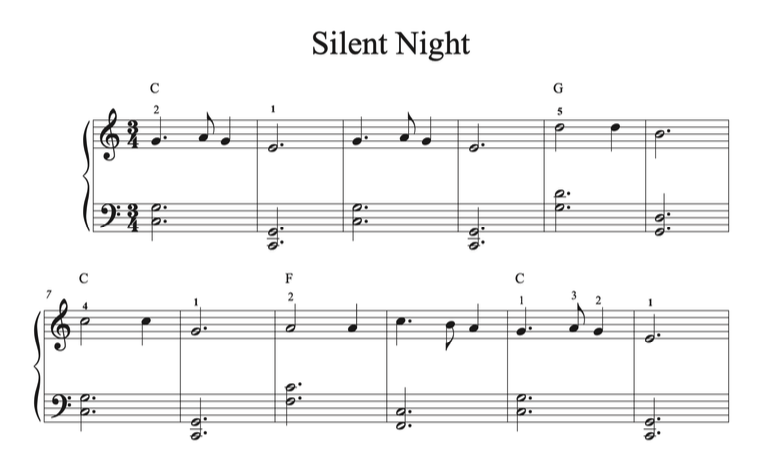
A lead sheet gives students the melody and chord symbols, leaving room to decide how to play the accompaniment.
Before exploring patterns, help your student find the chords and practice moving between them. Then choose a short section of “Silent Night” to try. There’s no need to tackle the whole carol at once!
If playing hands together feels like too much, make it a duet: you play the melody while your student explores the left-hand part.
Four left-hand patterns to explore
These patterns offer different sounds and levels of challenge. Start with one that feels comfortable, then introduce another when your student is ready.
1. Blocked chords: keep it simple
Play the notes of each chord together and let them ring until the next chord change.
This gives students time to think ahead, find the next chord, and listen to how the harmony supports the melody. Encourage a gentle touch so the accompaniment stays underneath the tune.
A simple accompaniment can still sound beautiful!
2. Broken triads: add gentle movement
Instead of playing all three chord tones together, play them one at a time.
For a C-major chord in root position, those notes are C–E–G. Help your student establish a steady pattern before adding the melody.
Ask: “Does this feel different from holding the chord?”
Students can begin hearing how the same harmony takes on a different character when its notes unfold.
3. Open fifths: explore a different register
Leave out the middle note of the triad and play just the root and fifth. For a C chord, that’s C and G.
Try the open fifth in one register, then move it an octave lower. Listen together to the change in sound. Does your student prefer the accompaniment closer to the melody, or farther below it?
This is a simple way to introduce another musical choice without adding more notes.
4. A spread pattern: root–fifth–third
For students ready to move beyond a five-finger position, try a broken pattern using the root, fifth, and third above it.
On a C chord, that’s C–G–E, with the E above the G.
The wider spacing creates a flowing accompaniment. Help students move comfortably between the notes, allowing the hand to travel rather than trying to hold a stretched position.
Practice the pattern on one chord first, then work on connecting it to the next.
Watch the patterns in action
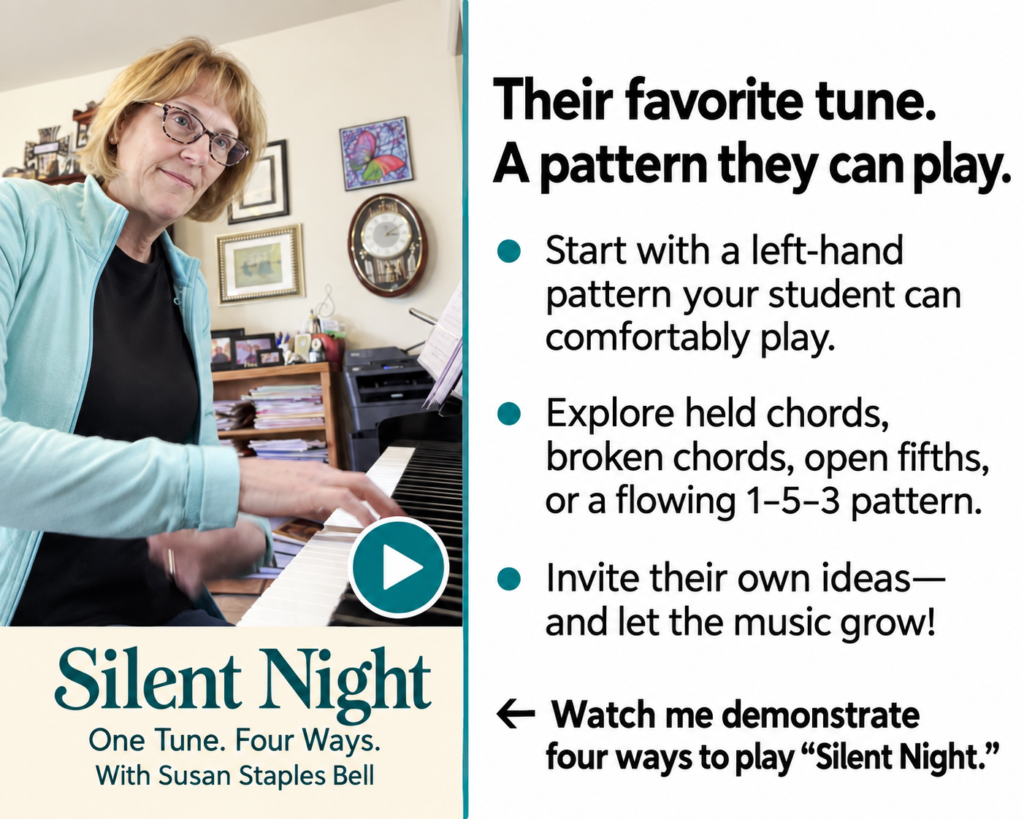
In this short video, I demonstrate four ways to accompany “Silent Night,” along with a pattern one of my students invented.
Let your student make the next choice
Once students have tried a couple of patterns, invite them to experiment:
Which accompaniment best fits the quiet character of “Silent Night”?
Could you use one pattern at the beginning and another later?
What happens when you move the accompaniment lower?
Can you invent a pattern using the same chord tones?
You don’t have to introduce all four patterns in one lesson. One new idea and a few minutes of exploration can be plenty.
The goal is to help students listen, choose, and discover that their musical ideas have value.
Try the idea with more Christmas favorites
Once a student finds a pattern they enjoy, try it with another familiar carol. Can they use the same idea with a different melody?
My 20 Favorite Christmas Lead Sheets collection gives students more opportunities to explore melody, chords, and accompaniment choices through Christmas music they know and love.
Explore 20 Favorite Christmas Lead Sheets and help your students create a Christmas sound of their own.


